
By Anne-Laure Esquirol, P.Eng., M.A.Sc.
In the start of a new year, nothing is more customary than wishing health and prosperity to others. When it comes to well-being, a simple parameter can influence our comfort and our respiratory vulnerability at once: relative humidity. Some tools, such as humidifiers, exist to control this parameter but understanding how they work and their potential effects on human health is imperative.
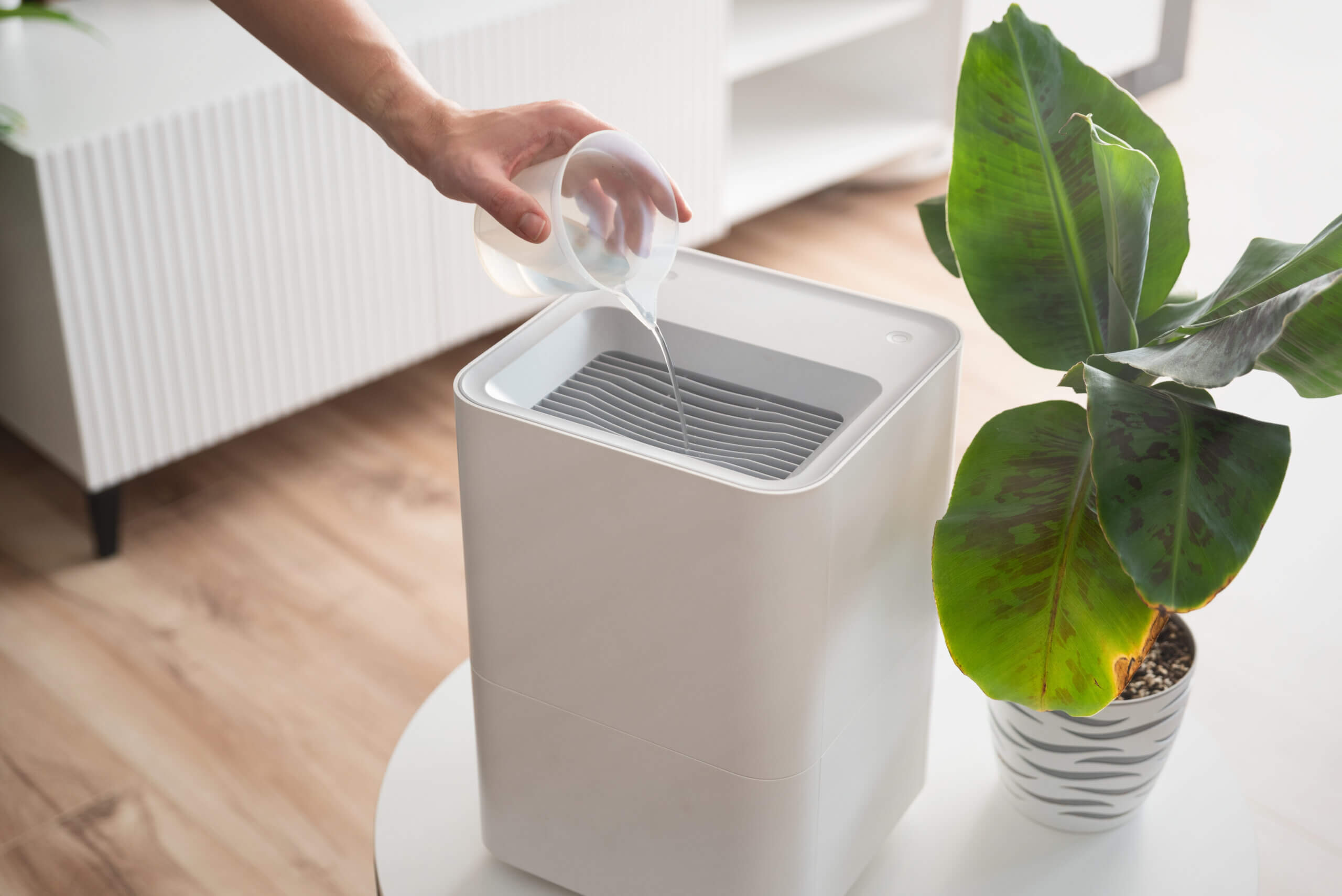
Indeed, a relative humidity level between 40% to 60% is considered optimal. Such levels reduce irritation of the mucous membranes, the survival of certain viruses, and symptoms associated with excessively dry air. Studies have shown that moderate humidity is beneficial to the immune system, and reduces the transmission of seasonal viruses, all the while excessively low humidity exacerbates symptoms of dry eyes and can irritate the respiratory tract.
To avoid these inconveniences caused by excessively low relative humidity levels, many people rely on the use of humidifiers. In this regard, two major technologies dominate the market: natural evaporation humidifiers and ultrasonic humidifiers.
Not All Humidifiers Are Made Equal
Natural evaporation humidifiers create water vapour through a process of evaporation, thus avoiding the formation of white dust and peaks in fine particulate matter (hereinafter PM).
By contrast, ultrasonic humidifiers vaporize water into micro-droplets. Everything that dissolves in water (minerals, metals, or micro-organisms) is propelled into the air and, when drying, generates fine particles (hereinafter PM2.5), sometimes at levels comparable to the world’s highest-polluting cities. The use of tap water in these devices is the cause of PM2.5, whereas distilled water avoids this phenomenon. Natural evaporation humidifiers do not exhibit this undesired effect, regardless of the mineral content.
Fine particles PM2.5 are particles of less than 2.5 micrometres that are suspended in the air, thus roughly 30 times smaller than a human strand of hair. Their minuscule size allows them to deeply penetrate the respiratory tract, reaching the pulmonary alveoli, where they can enter the bloodstream.
Prolonged exposure, or exposure to high concentrations, of PM2.5 levels are associated with adverse health effects (e.g., respiratory diseases, cardiovascular diseases, etc.). The use of tap water, generally mineralized, in an ultrasonic humidifier can transform a simple comfort-related action into one that causes significant indoor air pollution.
Another underestimated risk pertains to bioaerosols, such as biological particles suspended in the air (e.g., mould, spores, pollen, bacteria, etc.). Studies have shown that ultrasonic humidifiers can cause bacteria and fungi to become airborne. Therefore, it is recommended to use distilled or demineralized water, and to perform rigorous maintenance on the device.
Tests Taken in Our Laboratory
In our laboratory, we tested an ultrasonic humidifier with two sources of water: distilled water and tap water. With distilled water, at 1 metre from the device and at the height of 70 cm from the ground, we measured 0 micrograms per metre of air (µg/m³) of PM2.5 fine particles, regardless of the time of day. By contrast, with tap water, we observed 140 µg/m³ simply after activating the device. After three hours, we measured 230 µg/m³ at 70 cm from the ground and up to 360 µg/m³ at floor level.
After shutting down the device, the level dropped to 6 µg/m³ 30 minutes later and an hour later, levels were at 1 µg/m³, with the decrease depending on the ventilation. As mentioned, this use of ultrasonic humidifiers can expose occupants to concentration levels higher than those in the world’s most polluted cities.
Global Context and Canadian Standards
The IQAir World Quality Report 2024 ranks cities such as Byrnihat with 128 µg/m³, and Delhi with 108 µg/m³, both cities located in India. In the city of Lahore in Pakistan, an average concentration of 102 µg/m³ was recorded. In contrast, the use of an ultrasonic humidifier with tap water can cause indoor air levels that considerably exceed these values.
Canadian indoor air quality standards set thresholds for outdoor air at 27 µg/m³, over a 24-hour period, and at 8.8 µg/m³ for an annual average. All the while, the World Health Organization (WHO) recommends 5 µg/m³.
Best Practices for Healthy Air
In summary, to limit risks, it is best to use a natural evaporation humidifier, as they do not generate fine particles. However, if an ultrasonic humidifier device is kept, it is necessary to strictly use distilled or demineralized water and to frequently clean the device.
For comfort, humidity levels should target between 40% to 60% but in very cold weather, it is recommended that users do not exceed 30% to 35% to avoid condensation on windows and walls, which can lead to mold and damage. Home monitoring with a hygrometer is advised. Finally, it is essential to avoid using standing water, and to regularly disinfect the tanks to limit microbial growth.
Conclusion
In conclusion, when done properly, humidifying the air during the winter is beneficial. Choices such as humidifier type, water quality, rigorous maintenance, and adequate ventilation are key factors in protecting occupants’ health and maintaining an optimal air quality.
By comparison, during the record-breaking forest fires of 2023, when Quebec experienced episodes of extreme air pollution with concentrations of fine PM2.5 particles that sometimes exceeded 300 µg/m³ in Montreal, and up to 400 µg/m³ in certain regions such as Abitibi and Outaouais. These levels are 10 to 15 times higher than the established targets.
Under such conditions, it is strongly advised to avoid going outside, especially for young children, the elderly, or those with respiratory problems. Additionally, intense activities, such as playing sports, should be avoided as they increase the amount of air inhaled and, therefore, the exposure to particulate matter.