
How and Why Buildings React to Shaking Forces
By Paul Steneker, P.Eng., Ph.D.
When vibration-induced damage is suspected within a building, people often look at the foundation. Intuitively, this connection makes sense; however, damage to the foundation is not the only sign of trouble. Your attention should first be drawn closer to the roof, rather than the building’s foundation. The way in which people perceive shaking in a building can be overly conservative when it comes to assessing the level of damages incurred, as these bellwethers, or indicators of damaging vibrations may feel worse than they actually are. This article will give you some basic insights as to how buildings shake, why humans aren’t great at discerning the severity of shaking buildings, and what information to look for in the early stages of a vibration-related claim.
A common misconception
We tend to think of buildings as stable, stationary objects, but this is a simplification. All buildings sway and shake constantly. A house really does shift when the wind blows, but it’s usually at imperceivable amounts. The ground below the foundation also shifts, which tends to shake the building back and forth.
Vibrations of structures cause things to accelerate, move, and displace all at once. While we tend to think of the acceleration as being the cause of damage, displacement is the real threat. Some building materials, such as brick and plaster, are more susceptible to cracking from shifting displacement and deformations, and some locations within a building are more vulnerable to these displacements than others. More importantly, the relative displacement, which is the changing distance between two moving objects, can help identify the nature of the failure. If a whole building moves as a perfectly rigid block, chances of damage within the block are low. Since nothing is truly rigid, we are always watching for the point at which the flexibility of a material is pushed too far, resulting in the occurrence of cracking. Therefore, knowing how each building component and the structure itself, will respond is key in determining its sensitivity to vibrations.
The “tune” of a building
The amount and rhythm (or frequency) at which a building shakes is reasonably predictable. Using a guitar as an analogy, imagine the actions of a building being like a guitar string. A building tends to shake at a specific frequency, based on its construction and the weight of its contents, and will respond to tension or excitement by shaking at its own frequency. This means that any ground vibration will make the building move at its chosen natural rhythm instead of following the randomness of the ground shaking.
This also means that, like a guitar string, the largest amount of movement in a vibrating building does not usually occur at the point of contact (where a finger plucks a string) nor at the point of support (e.g., the foundation of a building), but occurs at the most flexible point. For guitars, this is the middle of the string. For buildings, the most flexible point is usually near the roof, as a building tends to amplify vibrations occurring at the base up to the roof, while simultaneously filtering away vibrations, leaving only its natural frequency.
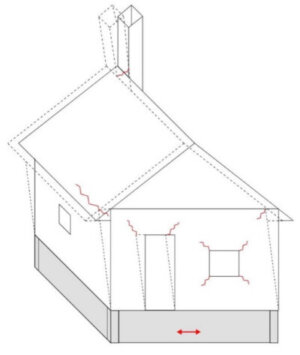
Most of the support system propagates these vibrations through the building’s natural frequency, that is, until a drastic change in the geometry occurs. This is where relative displacements can be problematic. Locations where two less compatible and flexible materials meet may be where the first cracks initiate. These places include:
- Where a flexible floor/ceiling meets a rigid wall
- Where a tall brick chimney intersects the roof
- At the corners of large windows
- Where a new modern addition connects to an old brick building
Therefore, when conducting a site examination for a vibration claim, the investigator does not simply stick to the basement. Before assessing what caused the damage (vibration-induced or not), understanding the building’s “tune” needs to be established first. This information will then direct the focus of the investigation and help identify locations within the building that may have sustained damage due to vibrations.
How to discern what is too big or too small
When it comes to detecting vibrations, people are very sensitive and are unreliable detectors to discern whether a serious vibration issue exists or not. Humans start to feel vibrations at more than 10 times below the level which could damage even the most sensitive building finishes. In the last few decades, floor vibrations and human occupant comfort levels have become a new focus in the building industry and substantial research has been undertaken to quantify discernable and comfortable levels of vibrations, which are levels far below the established limits for damage to buildings.
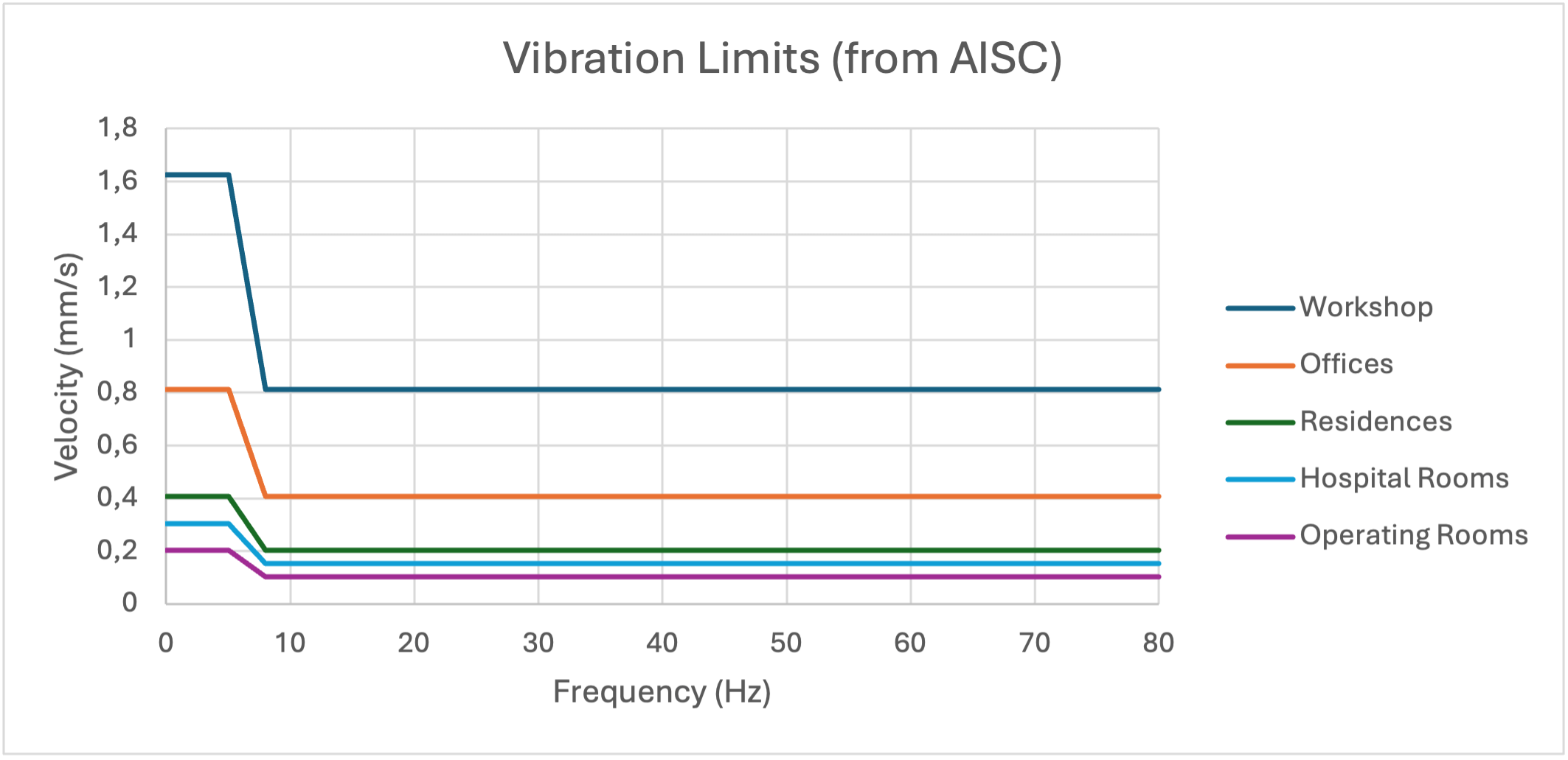
Vibration limits are based on the results of multiple tests, conducted on various activities a person may be undertaking, and taking into consideration the environment to which they are exposed. For example, a person sitting in a quiet office is more sensitive to vibrations than someone participating in a dance class. Vibrations are quantified using a peak velocity, measured in millimetres per second (mm/s). Furthermore, like buildings and guitar strings, our bodies have their own natural frequency. At different frequencies, vibrations tend to resonate with our organs, sometimes causing a jarring feeling. Vibration limits are therefore calibrated to prevent this feeling of discomfort, across many different occupancies. A set of these limits was published by the American Institute of Steel Construction (AISC), as shown in the following graph:
Our bodies are also more sensitive to vibrations the longer we are exposed to them. Unlike someone sitting in their home office who is exposed to low intensity shaking all day, a large single vibration caused by an impact outside of a building will not be as uncomfortable to occupants inside that building. After a few minutes of exposure, even small vibrations become sources of discomfort and cause for complaint. The same is partially true for structures.
As mentioned, earlier, most people fail to comprehend the magnitude of a building that is shaking and challenges identifying the thresholds of damaging vibrations are difficult to detect to the untrained observer. Buildings and their finishes can withstand vibrations long after people have become uncomfortable. Several published guidelines have been utilized for setting limits on vibrations, including studies conducted by the U.S. Bureau of Mines (USBM) over the last 100 years. However, the most generally accepted standard would be Standard DIN 4150 from Germany, which contains limits for both normal and historical buildings, and includes older materials such as plaster and brick. These limits are measured at the ground, near the foundation of a building and are shown in the following graph:
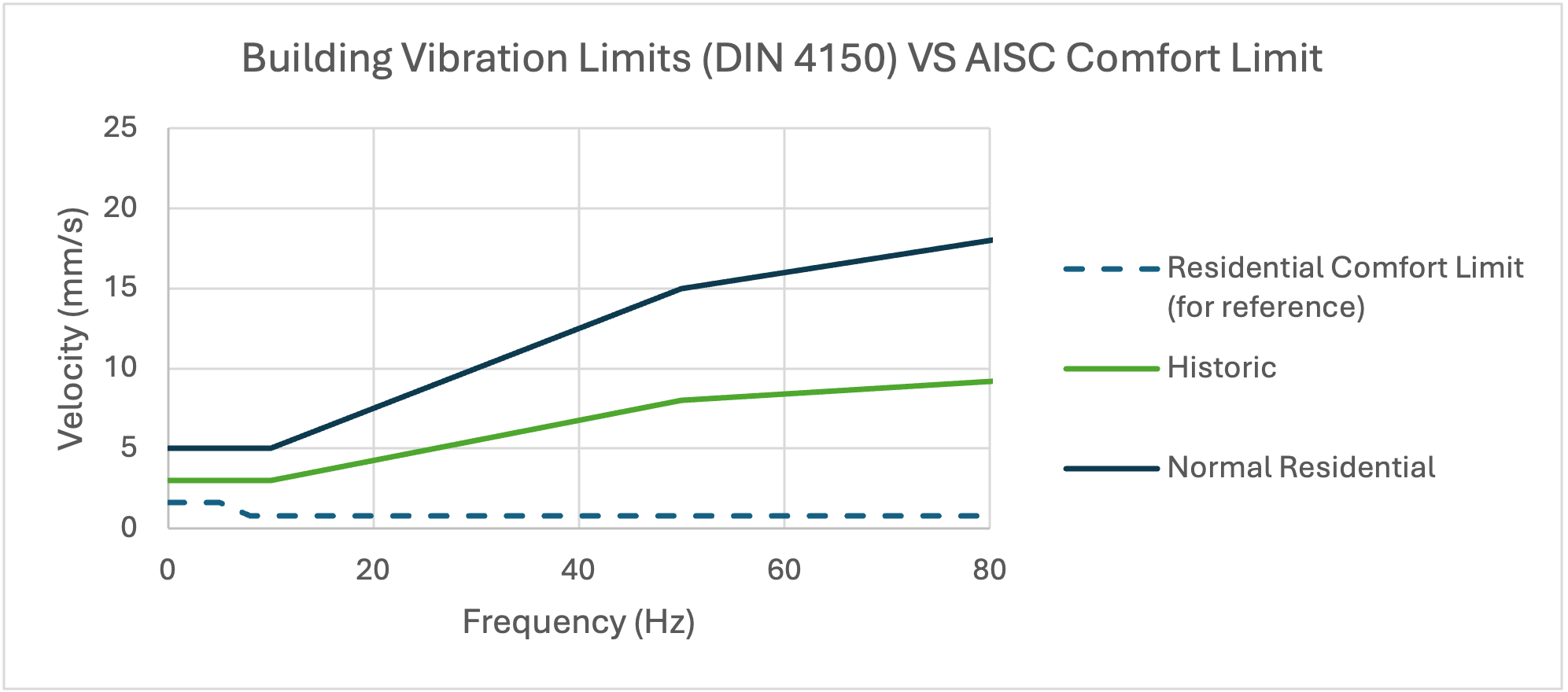
Notice how the y scale values (the three coloured lines in the graph) are different, and how far apart the Residential Comfort Limit from AISC is to the Normal Residential (damaging) Limit. Humans can feel uncomfortable at half, to more than ten times less, than that which would begin to damage a building’s finish, let alone its structure. Also, as buildings tend to amplify vibrations through their own natural frequency, most buildings will resonate, or tune, with vibrations at less than 10 Hz. This is why vibration limits change, based on the different frequencies. It is also why human vibration comfort and vibration building damage are not well correlated.
What are the expert’s initial steps in responding to a call?
Most vibration-related complaints are often due to human activities, such as a nearby municipal road construction project. In this scenario, to evaluate the probability of damage being caused by construction, it is good to know what type of activities had been undertaken prior to the awareness of vibration, or failure.
Excavation in rock, particularly blasting, can reach damaging levels if the conditions are right. Whereas jack hammering and compaction do not usually have enough energy to cause significant damage to most residential structures. While unpleasant to the occupant, the high frequency vibrations from hammering don’t synchronize well with the tune of the building and chances are that the crack in the house’s foundation had not been caused by these minor construction activities.
Most vibration causing projects begin with a pre-construction survey, which is one of the first pieces of information obtained during a vibration-related investigation. Experienced contractors are aware of the required needs of municipalities; they also know that local residents tend to complain about nearby vibrations from machinery. These contractors can disprove most of these claims by providing evidence of previous damage having existed prior to the current construction project. For these reasons, when undertaking blasting in city limits, most municipalities enforce contractors to implement a vibration monitoring program to record the vibrations in the ground and maintain them below specific limits (such as the DIN limits). The results of this vibration monitoring may not be easily attainable but, when they do exist, they are a gold mine of information.
Once retained, a professional engineer will typically begin the investigation by acquiring the knowledge outlined in this article. Likewise, an insurance adjuster or occupant might be able to assist in the initial phase by answering some of the questions presented above. Taking these first steps in the early stage of an investigation will save both time and money when resolving a vibration-related claim.
Summary
We know that vibration frequencies which affect humans are different to those that damage buildings. Furthermore, humans are much more sensitive to vibrations than most structures. Typical construction related activities often cause significant unpleasantness to occupants before causing damage to buildings, and scientific research has been completed to demonstrate this.
A vibration related claim should be investigated thoroughly by an expert, as an examination of the structure is required to determine its “tune”. Furthermore, construction activities causing vibrations often have monitoring programs which provide helpful insights on causation. CEP Forensic is ready to assist whenever and wherever vibrations occurred.