
By Marie Soula, Ph.D., P.Eng.
Each year, CEP Forensic analyzes hundreds of parts from across Canada. In most cases, these parts are easily identifiable thanks to markings, engravings, or labels applied by the manufacturer or distributor. However, a significant proportion of the parts received contain little to no information that would make it possible to trace their origin. In the context of subrogation claims, identifying the manufacturer or distributor represents a critical strategic issue.
An unidentified part can lead to significant legal and financial consequences, ranging from delays in handling the case to the impossibility of pursuing a claim. In this context, the role of the materials expert is crucial. In addition to analyzing the cause of failure, the expert plays a key role in identifying the parts. Drawing on experience, tools, and CEP Forensic’s internal resources, the expert conducts a thorough technical investigation to gather the necessary information and effectively support recovery efforts.
The CEP Forensic Database
For several decades, CEP Forensic has carried out materials expertise in a wide range of contexts across Canada. All information collected during these assignments is centralized in an internal database, which now serves as an essential reference tool for experts.
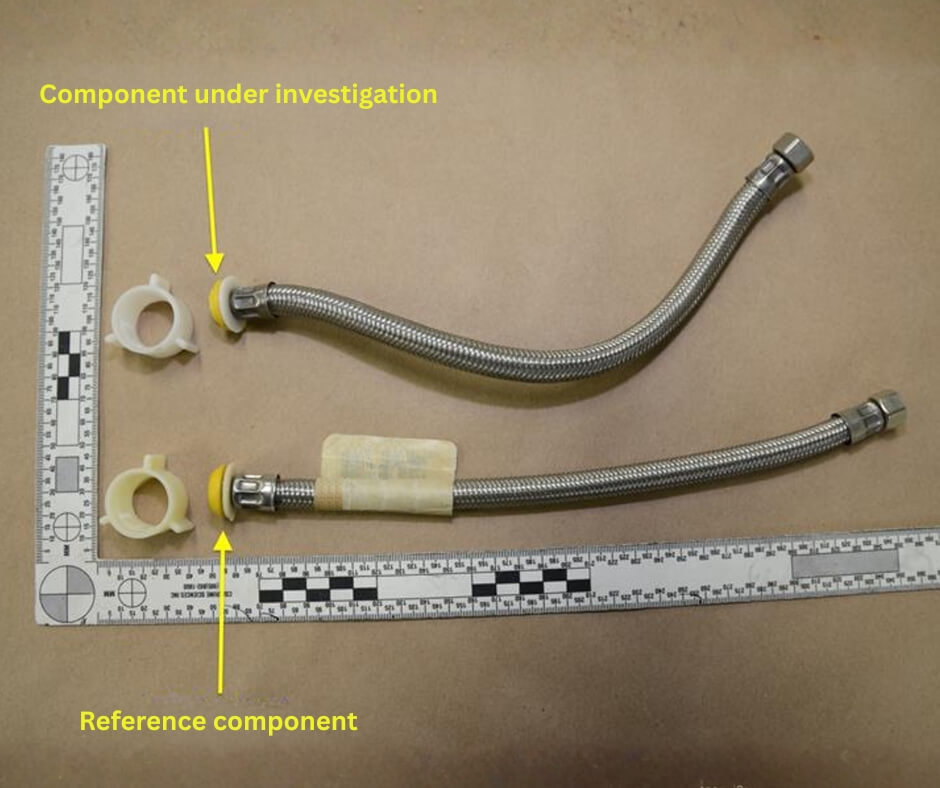
This database includes, among other things, detailed photographs of parts analyzed in the past, some of which still bore labels or markings clearly indicating their manufacturer or distributor. Even when the part currently being studied no longer retains this information, comparison with visually similar parts from previous cases can sometimes make it possible to establish a decisive link.
The database also contains technical datasheets, catalogs and documents to help trace the origin of certain parts used in specific systems. Finally, email exchanges with manufacturers or distributors have been preserved and recorded. These communications may provide confirmation, clarification, or valuable technical information when analyzing subsequent cases. Thanks to this structured accumulation of data and experience, the CEP Forensic database enables experts to go beyond the limitations of the part itself and to effectively support the identification of the parties involved.
The Museum
In addition to the digital database, CEP Forensic has developed a true “museum” of parts over the years, bringing together remarkable examples and unusual failures encountered in previous investigations. This physical collection is a unique resource that is readily accessible to experts and plays a key role when the identification of a part proves complex.
Visual and morphological comparison between the analyzed part and those preserved in the museum can sometimes reveal a distinctive geometry, material type, or failure mode that is associated with a particular manufacturer or product family.
Specifically Purchased Parts
In some cases, the reported facts suggest that a part was purchased from a particular distributor. However, it may not be possible to formally confirm this information when initiating a claim, particularly due to the absence of invoices, documentary evidence or references on distributors’ websites. Products may have been modified, withdrawn from the market or replaced by newer versions, making traceability even more difficult.
In such situations, CEP Forensic experts may go beyond laboratory analysis and visit distributors directly to verify whether the parts in question are still available on the market. This approach is particularly relevant when dealing with local distributors, where turnover may be slower and older products may still be in inventory.
Importance of the Distributor
In subrogation cases, identifying the distributor of the defective part often represents a decisive lever. Based on CEP Forensic’s experience, this step often helps to advance a case, even when the manufacturer cannot be definitively identified.
Unlike some manufacturers that may have ceased operations or are difficult to trace, distributors are generally still in operation. As the entities that placed the part on the market, distributors retain responsibility for the products they have distributed. Identifying them enables legal action to be initiated, potentially involving the manufacturer.
However, all collected information, observations and research are carefully preserved and documented. Experts remain attentive to developments in other cases and communicate regularly with colleagues, as analyzing a new case can provide new insights into older ones. This collaborative approach, based on CEP Forensic’s accumulated experience, can sometimes lead to renewed progress in cases once considered closed.