
By Michael Beaudry, E.I.T.
Over the past decade, personal mobility devices have become an increasingly common component of everyday transportation. Whether driven by lower ownership costs, advancing technology, or the growing prevalence of ride-sharing services, more people are incorporating micromobility devices into their daily commutes. However, the rapid growth of micromobility has outpaced the development of laws and regulations in many jurisdictions. This has resulted in unclear definitions of micromobility devices, inconsistent regulations, and uncertainty surrounding their legal use. For insurers, adjusters, and legal professionals, understanding how these devices are classified and regulated is just as important as understanding the circumstances of an incident when assessing liability, coverage, and damages.
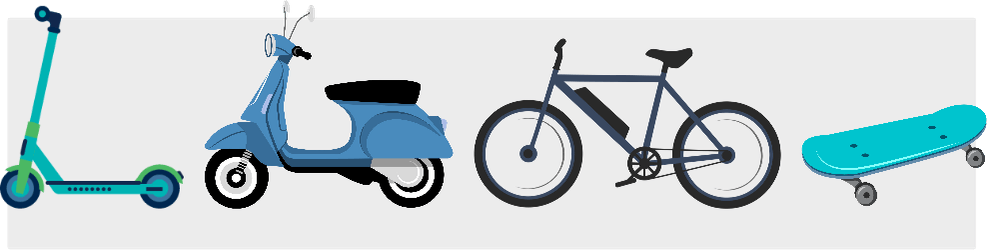
Micromobility refers to the use of small, lightweight vehicles designed to transport one or two people over relatively short distances. These vehicles may be human-powered, electrically assisted, or fully electric, and include devices such as unicycles, bicycles, tricycles, scooters, skateboards, and hoverboards.
The Rise of Micromobility Devices
Advancements in battery and electric motor technology have fuelled the rapid growth of micromobility devices, resulting in a wide variety of options available to consumers. Their convenience, affordability, and compact design make them an attractive solution for short-distance travel, whether commuting to work, running errands, or connecting with public transit.
The most common micromobility devices are e-scooters and e-bikes; but however, at CEP Forensic, we have noticed growing trends in alternatives such as e-skateboards, e-tricycles, and even e-unicycles!
Evolving Regulations Across the Country
The wide variety of micromobility devices available today presents a unique regulatory challenge. Legislation must be broad enough to encompass a diverse range of vehicles while remaining specific enough to establish the rights, responsibilities, and operational requirements of users in public spaces. Across the country, every province has individual laws pertaining to micromobility devices, and many provinces have adopted an opt-in style pilot program, where general rules and regulations are set by the provincial transportation acts and the finer details are outlined in municipal bylaws.
have adopted local regulations for governing the use of micromobility devices. Most of these municipalities have distinct rules regarding where and how these devices can be operated. That’s almost 80 sets of rules to be familiar with, in addition to provincial and territorial safety acts!
For Example:
- British Columbia has different regulations outlined for the use of e-bikes and e-scooters, with e-scooters only being allowed in communities participating in a pilot program that is scheduled to end in 2028.
- Manitoba is expected to introduce new legislation in 2027 that will establish rules and definitions for micromobility devices, referred to in the legislation as Personal Electric Vehicles (PEVs). These changes are intended to provide a more consistent regulatory framework and improve the understanding of these devices across the province.
- Ontario is running an e-scooter pilot program until 2029, that outlines requirements for e-scooters and their riders, while allowing municipalities to define where e-scooters can be used and what type of insurance is required. Toronto has chosen not to participate in this pilot program and does not allow e-Scooters on any public property, instead recommending riders to use e-bikes as a safe and legal alternative.
- Nova Scotia amended its Traffic Safety Act in 2026 to include micromobility devices. Under the Act, micromobility devices are generally treated in a manner similar to bicycles, while municipalities are granted the authority to establish their own rules, regulations, and operational requirements governing the use of these devices within their jurisdictions.
So, how do we determine which regulations apply and what impact they may have on liability?
1. Identify the jurisdiction
Determine what city and province the incident occurred, so as to determine applicable provincial and municipal laws at the time of the incident.
2. Identify the incident location
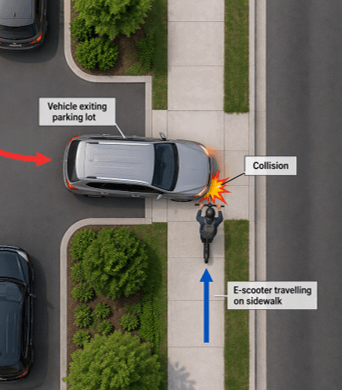
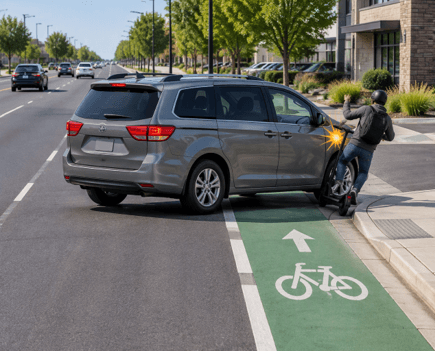
Determine if the incident occurred on a public roadway, private property, sidewalk, bicycle lane, or other.
3. Identify the device involved
Determine what kind of mobility device was being used and how it is defined in legislation.
4. Reconstruct the collision events
Review the evidence, evaluate collision dynamics and determine contributing factors.
5. Determine whether the device was being used as permitted under applicable regulations
Determine if the device was permitted to be used at the incident location, and if the operator was using it in a way permitted within legislation.
Remember: Every province, territory, and municipality in Canada approaches micromobility differently. Understanding the specific rules that apply at the time and location of an incident is critical to determining liability.
Investigating Micromobility Incidents
Increasing claim frequency, evolving regulations, and ongoing technological advancements mean that every micromobility-related incident must be carefully examined on its own merits. At CEP Forensic, we approach each investigation with the level of technical analysis required to understand not only what happened, but why it happened. Micromobility devices can exhibit unique collision dynamics that differ significantly from those of conventional motor vehicles, influencing injury mechanisms and causation analyses. In many cases, telematics data and onboard electronic records can assist in establishing operating speeds and travel paths prior to an incident. Physical evidence at the scene, including roadway conditions, visibility constraints, and tire scuff marks can further support the reconstruction of events.
The Rise of Micromobility Devices
Most micromobility devices are equipped with a 48 V battery and are electronically limited to power outputs of approximately 500 W and operating speeds ranging from 20 to 32 km/h. These limitations are generally intended to align with local regulatory requirements, although they can be difficult to enforce in practice. Many manufacturers also offer higher-performance configurations or models that are not intended, and in some jurisdictions not permitted, for use on public roadways. For example, electric motorcycles commonly referred to as e-motos or electronic dirtbikes have roughly the same footprint as a compliant e-bike and have power upwards of 3,000 W and 145 N-m of torque; that’s roughly the same torque as a 2005 Honda Civic, but only a twentieth of the weight.
Many micromobility devices are marketed and sold as e-bikes, but do not meet provincial and federal requirements for operation on public roadways. Some of these devices are capable of peak power outputs exceeding 1,100 W and top speeds of 45 km/h or more. While many manufactures electronically limit power output and speed to comply with applicable regulations, riders are often able to override these restrictions and “tune” their devices to accelerate faster and reach top speeds only intended for motor vehicles. When speed and compliance is a concern, a examination of the involved device can be invaluable. Physical inspection, electronic diagnostics, and performance testing may reveal that the device was capable of operating beyond the manufacturers stated specifications, indicating tampering and modification of the device’s components.
The Rise of Micromobility Devices
The earlier our experts become involved, the greater the likelihood of preserving critical evidence and obtaining reliable technical data. Early intervention can be instrumental in accurately reconstructing an incident, understanding the sequence of events, and determining the factors that contributed to the outcome. Armed with complete and reliable information, our experts can assess potential causes such as rider error, mechanical failure, roadway and visibility conditions, and the opportunities available to avoid or mitigate the incident.